


Nathan Cyrille PhD thesis
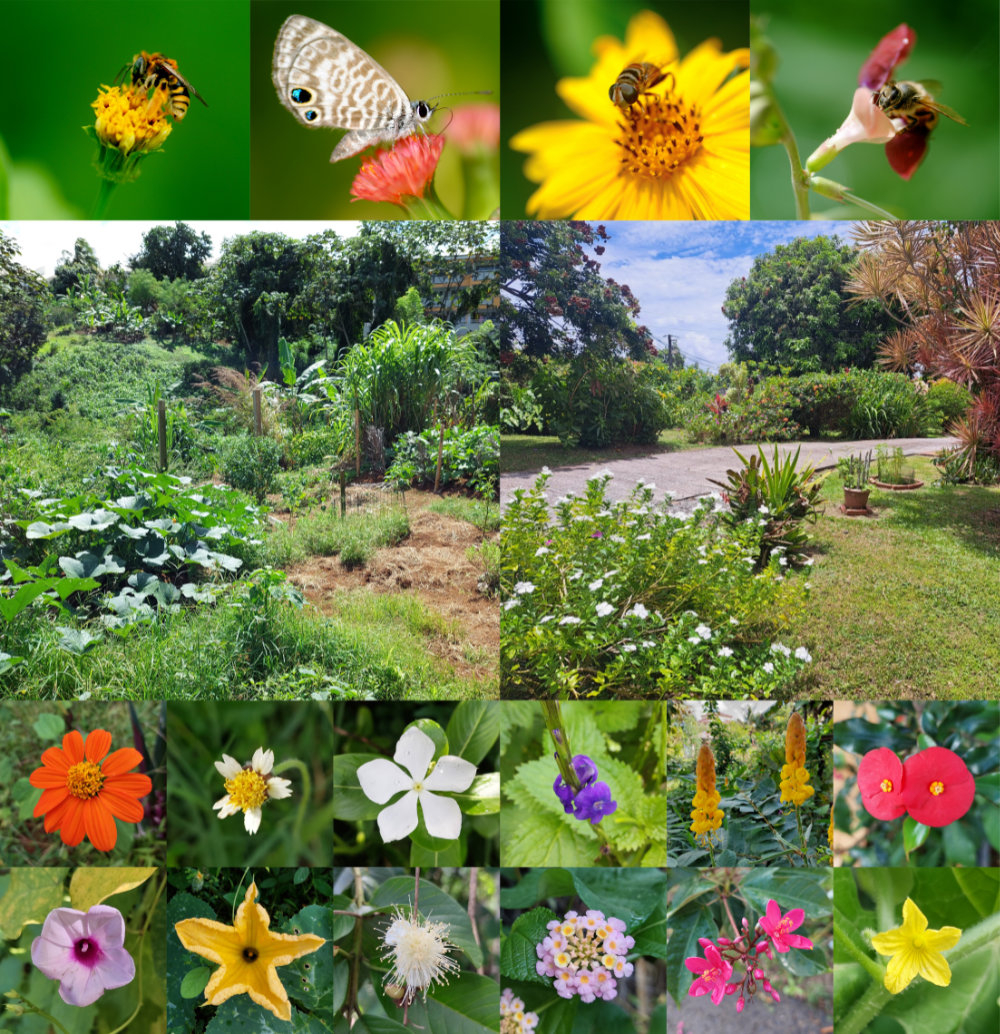 Gardens and pollinators in a tropical island environment: effects of seasonality and floral offer on pollinator assemblages and their interactions with flora in Martinique
Started in october 2021
Funding: doctoral grant
Supervisor: François Bretagnolle ; cosupervisor: Marie-Jeanne Perrot-Minnot
Defended the 19 december 2025
Abstract
Urbanisation is expanding at an unprecedented rate, profoundly transforming landscapes and altering the ecological processes that sustain biodiversity. This transformation often leads to the degradation, fragmentation, and loss of natural habitats, imposing intense, multifactorial pressures on pollinators. Within the artificialised matrix, gardens may serve as refuges for pollinators, notably by providing a substantial share of available floral resources. Their floral composition and structure vary seasonally, under the combined influence of garden management and phenological cycles. Investigating how the floral offer of gardens shapes pollinator assemblages is therefore essential to assessing gardens’ potential to support pollinators. This is particularly critical in the Caribbean islands, a biodiversity hotspot undergoing rapid urban growth. In this context, the floral offer of ten garden sites in Martinique (Lesser Antilles) and their interactions with diurnal pollinators were monitored monthly over one year. This study shows that the composition and structure of the floral offer strongly influence pollinator assemblages and the architecture of plant-insect interactions, with contrasting effects among plants depending on their human use. A marked seasonal decoupling was also observed, with wild insect pollinator richness and abundance peaking during the wet season when garden floral resources were lowest, and being minimal when floral availability was highest. Moreover, the dominance of the super-generalist species Apis mellifera in gardens appeared to constrain wild insects’ resource use and reduce their abundance, highlighting a key limitation on gardens’ capacity to support wild pollinators. Overall, this thesis shows that garden management and seasonality are key drivers of pollinator assemblages in tropical gardens, and emphasises the ecological value of the spontaneous herbaceous flora. These results underscore the importance of actively incorporating gardens into urban biodiversity planning.
Keywords
plant-pollinator interactions; seasonal dynamics; floral offer; garden management; Apis mellifera; Caribbean
Thesis advisory panel
Adam Vanbergen (INRAE – Agroécologie, Dijon)
Colin Fontaine (MNHN – CESCO, Paris)
jury
Benoît Geslin, université de Rennes – reviewer
Alice Michelot-Antalik, université de Lorraine – reviewer
Emmanuelle Baudry, Université Paris-Saclay – examiner
Isabelle Dajoz, Université Paris Cité – examinatrice
James Desaegher, INRAE Avignon – examinateur
Thierry Rigaud, Université Bourgogne Europe – examinateur
Adam J.Vanbergen, INRAE Dijon – invité
François Bretagnolle, Université Bourgogne Europe – directeur de thèse
Marie-Jeanne Perrot-Minnot, Université Bourgogne Europe – directrice de thèse
- extrait:
- lien_externe:
- titre:
- Caractérisation et dynamique des réseaux de pollinisation sur un gradient d’urbanisation dans les Antilles françaises
- date_de_debut_these:
- octobre 2021
- nom:
- Cyrille
- date_de_debut_these_numerique:
- 202110
- kc_data:
- a:8:{i:0;s:0:"";s:4:"mode";s:0:"";s:3:"css";s:0:"";s:9:"max_width";s:0:"";s:7:"classes";s:0:"";s:9:"thumbnail";s:0:"";s:9:"collapsed";s:0:"";s:9:"optimized";s:0:"";}
- kc_raw_content:
- Gardens and pollinators in a tropical island environment: effects of seasonality and floral offer on pollinator assemblages and their interactions with flora in Martinique
Started in october 2021
Funding: doctoral grant
Supervisor: François Bretagnolle ; cosupervisor: Marie-Jeanne Perrot-Minnot
Defended the 19 december 2025
Abstract
Urbanisation is expanding at an unprecedented rate, profoundly transforming landscapes and altering the ecological processes that sustain biodiversity. This transformation often leads to the degradation, fragmentation, and loss of natural habitats, imposing intense, multifactorial pressures on pollinators. Within the artificialised matrix, gardens may serve as refuges for pollinators, notably by providing a substantial share of available floral resources. Their floral composition and structure vary seasonally, under the combined influence of garden management and phenological cycles. Investigating how the floral offer of gardens shapes pollinator assemblages is therefore essential to assessing gardens’ potential to support pollinators. This is particularly critical in the Caribbean islands, a biodiversity hotspot undergoing rapid urban growth. In this context, the floral offer of ten garden sites in Martinique (Lesser Antilles) and their interactions with diurnal pollinators were monitored monthly over one year. This study shows that the composition and structure of the floral offer strongly influence pollinator assemblages and the architecture of plant-insect interactions, with contrasting effects among plants depending on their human use. A marked seasonal decoupling was also observed, with wild insect pollinator richness and abundance peaking during the wet season when garden floral resources were lowest, and being minimal when floral availability was highest. Moreover, the dominance of the super-generalist species Apis mellifera in gardens appeared to constrain wild insects’ resource use and reduce their abundance, highlighting a key limitation on gardens’ capacity to support wild pollinators. Overall, this thesis shows that garden management and seasonality are key drivers of pollinator assemblages in tropical gardens, and emphasises the ecological value of the spontaneous herbaceous flora. These results underscore the importance of actively incorporating gardens into urban biodiversity planning.
Keywords
plant-pollinator interactions; seasonal dynamics; floral offer; garden management; Apis mellifera; Caribbean
Thesis advisory panel
Adam Vanbergen (INRAE – Agroécologie, Dijon)
Colin Fontaine (MNHN – CESCO, Paris)jury
Benoît Geslin, université de Rennes - reviewer
Alice Michelot-Antalik, université de Lorraine - reviewer
Emmanuelle Baudry, Université Paris-Saclay - examiner
Isabelle Dajoz, Université Paris Cité - examinatrice
James Desaegher, INRAE Avignon - examinateur
Thierry Rigaud, Université Bourgogne Europe - examinateur
Adam J.Vanbergen, INRAE Dijon - invité
François Bretagnolle, Université Bourgogne Europe - directeur de thèse
Marie-Jeanne Perrot-Minnot, Université Bourgogne Europe - directrice de thèse