


Myriam Marsot PhD thesis
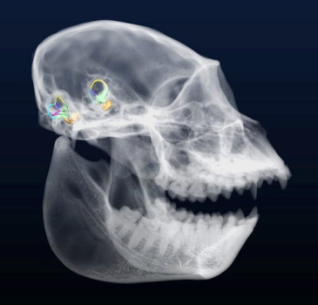 Morphological and functional variation in primate ears: intra- and interspecific approaches, between phylogenetic, allometric and ecological constraints
Started in october 2022
Funding: French ministry of research and higher education
Supervisors: Sébastien Couette & Patricia Balaresque
Defended the 18 december 2025
Résumé
The ear is a complex sensory system shaped by phylogenetic, allometric, and ecological constraints, whose diversity remains poorly documented beyond a few model species. This dissertation explores the evolution of the primate ear by combining morphological and functional approaches across multiple scales of analysis, from individuals to major clades of the order. Our analyses show that auditory structures exhibit intra-specific stability in individuals of the same age, which supports their comparison at the interspecific scale even with limited sample sizes. 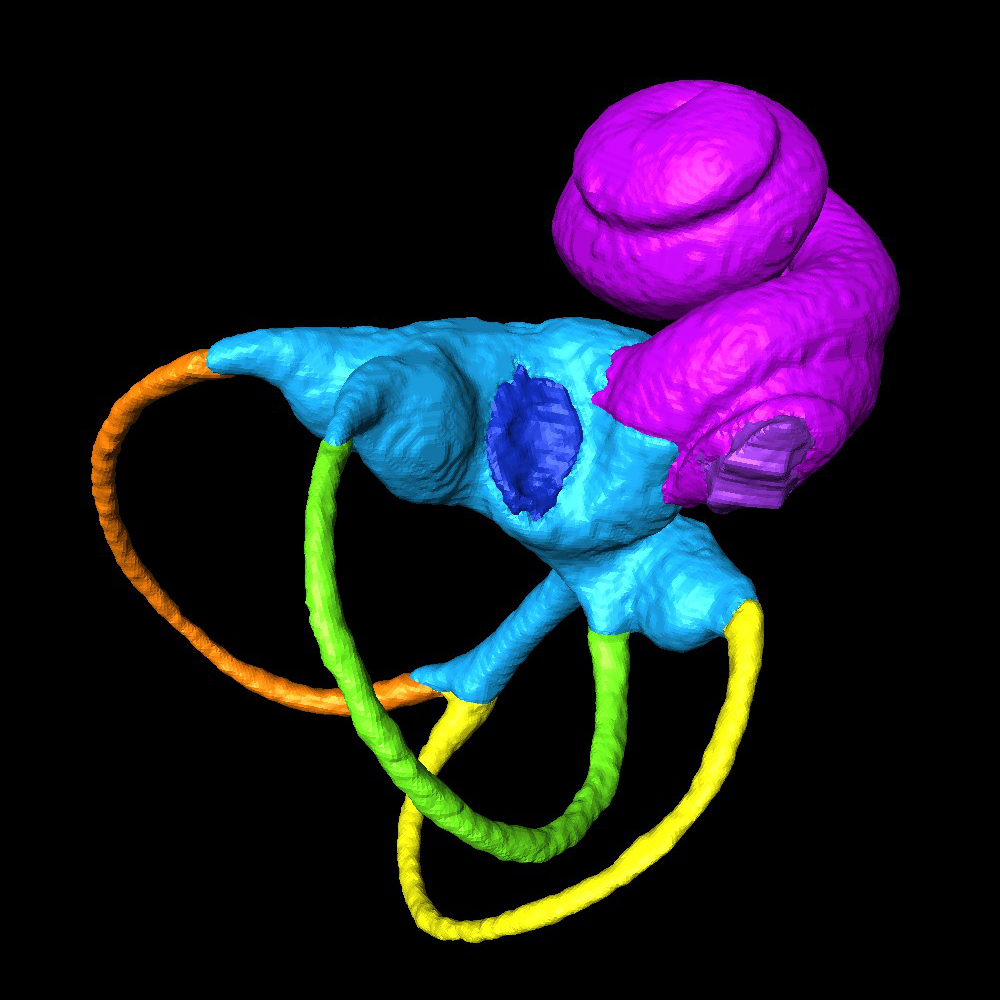 At this comparative scale, the analysis of functional auditory morphology reveals morphoacoustic groupings that are sometimes polyphyletic (Tarsiiformes, Catarrhini, Platyrrhini–Strepsirrhini groups), reflecting distinct evolutionary trajectories but only weakly explaining ecological differences once phylogeny is accounted for. The study of 3D cochlear shape refines this frame: while morphological structuring remains primarily determined by phylogeny and allometry, some specialized groups follow their own allometric trajectories and reveal covariation patterns between cochlear form and ecological setting. Finally, functional analysis of hearing based on otoacoustic emissions highlights the predominant role of the environment in shaping response amplitudes, as well as the influence of certain biological traits on frequency sensitivity. Overall, this work demonstrates that the primate ear is structured by evolutionary history and allometric constraints, but also modulated by ecological and environmental factors. By combining scales (intra- and interspecific) and dimensions (functional morphology, 3D morphometrics, and auditory sensitivity), this dissertation provides an integrated framework for understanding the sensory evolution of primates and opens perspectives for paleontological applications, notably the use of the ear as a potential proxy to infer the ecological and auditory niches of fossil species.
Keywords
bioacoustics, evolution, ear sensitivity, sensory ecology, macroevolution
Jury
Amélie Beaudet, laboratoire PALEVOPRIM, UMR 7262, Poitiers – reviewer
Maëva Orliac, UMR ISEM, Montpellier – reviewer
Sophie Montuire, EPHE PSL, Dijon – examiner
Jacob C. Dunn, Faculty of Science and Engineering, Anglia Ruskin University, Cambridge (UK) – examiner
Sébastien Couette, EPHE PSL, Dijon – cosupervisor
Patricia Balaresque, laboratoire CRBE, UMR 53000, Toulouse – cosupervisor
- extrait:
- lien_externe:
- titre:
- Bioacoustique chez les primates actuels et fossiles
- date_de_debut_these:
- octobre 2022
- nom:
- Marsot
- date_de_debut_these_numerique:
- 202210
- kc_data:
- a:8:{i:0;s:0:"";s:4:"mode";s:0:"";s:3:"css";s:0:"";s:9:"max_width";s:0:"";s:7:"classes";s:0:"";s:9:"thumbnail";s:0:"";s:9:"collapsed";s:0:"";s:9:"optimized";s:0:"";}
- kc_raw_content:
- Morphological and functional variation in primate ears: intra- and interspecific approaches, between phylogenetic, allometric and ecological constraints
Started in october 2022
Funding: French ministry of research and higher education
Supervisors: Sébastien Couette & Patricia Balaresque
Defended the 18 december 2025
Résumé
The ear is a complex sensory system shaped by phylogenetic, allometric, and ecological constraints, whose diversity remains poorly documented beyond a few model species. This dissertation explores the evolution of the primate ear by combining morphological and functional approaches across multiple scales of analysis, from individuals to major clades of the order. Our analyses show that auditory structures exhibit intra-specific stability in individuals of the same age, which supports their comparison at the interspecific scale even with limited sample sizes.
At this comparative scale, the analysis of functional auditory morphology reveals morphoacoustic groupings that are sometimes polyphyletic (Tarsiiformes, Catarrhini, Platyrrhini–Strepsirrhini groups), reflecting distinct evolutionary trajectories but only weakly explaining ecological differences once phylogeny is accounted for. The study of 3D cochlear shape refines this frame: while morphological structuring remains primarily determined by phylogeny and allometry, some specialized groups follow their own allometric trajectories and reveal covariation patterns between cochlear form and ecological setting. Finally, functional analysis of hearing based on otoacoustic emissions highlights the predominant role of the environment in shaping response amplitudes, as well as the influence of certain biological traits on frequency sensitivity. Overall, this work demonstrates that the primate ear is structured by evolutionary history and allometric constraints, but also modulated by ecological and environmental factors. By combining scales (intra- and interspecific) and dimensions (functional morphology, 3D morphometrics, and auditory sensitivity), this dissertation provides an integrated framework for understanding the sensory evolution of primates and opens perspectives for paleontological applications, notably the use of the ear as a potential proxy to infer the ecological and auditory niches of fossil species.Keywords
bioacoustics, evolution, ear sensitivity, sensory ecology, macroevolution
Jury
Amélie Beaudet, laboratoire PALEVOPRIM, UMR 7262, Poitiers - reviewer
Maëva Orliac, UMR ISEM, Montpellier - reviewer
Sophie Montuire, EPHE PSL, Dijon - examiner
Jacob C. Dunn, Faculty of Science and Engineering, Anglia Ruskin University, Cambridge (UK) - examiner
Sébastien Couette, EPHE PSL, Dijon - cosupervisor
Patricia Balaresque, laboratoire CRBE, UMR 53000, Toulouse - cosupervisor