


Séminaire jeudi 25 juin 2026
 Orbital forcing of global warming events, and the PETM
Pam Vervoort, université de Californie, Riverside (US)
Jeudi 25 juin 2026
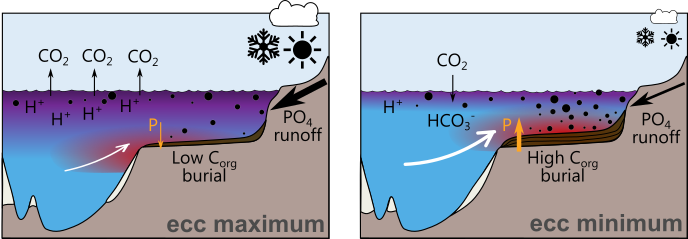
Milankovitch cycles in sedimentary archives demonstrate the influence of orbital forcing on Earth’s climate. A well-known example is the 100 kyr (eccentricity) glacial-interglacial cycles of the last million years. During warmer intervals of the earlier Cenozoic and Mesozoic, large eccentricity-paced δ13C excursions and associated global warming events also occurred. These ‘hyperthermal’ events suggest periodic massive carbon release, but the responsible reservoirs and mechanisms that are sensitive to orbital forcing in ice-free climates are poorly understood. In this talk, I demonstrate one possible mechanism: the ocean itself can switch between acting as a CO2 source and sink and thereby regulate climate on orbital timescales. This process may be especially important during greenhouse intervals with low-oxygen oceans, such as the Early Eocene Climatic Optimum (EECO).
Multiple hyperthermals have been identified throughout the EECO, most are orbitally paced. However, the role of orbital forcing during the largest of these events—the Paleocene Eocene Thermal Maximum (PETM) remains debated. I will also discuss how the PETM compares with other hyperthermals and examine the role of orbits and other carbon cycle feedback processes in shaping the PETM.
- extrait:
- lien_externe:
- titre:
- Orbital forcing of global warming events, and the PETM
- intervenant:
- Pam Vervoort
- date:
- jeudi 25 juin 2026
- kc_data:
- a:8:{i:0;s:0:"";s:4:"mode";s:0:"";s:3:"css";s:0:"";s:9:"max_width";s:0:"";s:7:"classes";s:0:"";s:9:"thumbnail";s:0:"";s:9:"collapsed";s:0:"";s:9:"optimized";s:0:"";}
- kc_raw_content:
- Orbital forcing of global warming events, and the PETM
Pam Vervoort, université de Californie, Riverside (US)
Jeudi 25 juin 2026
Milankovitch cycles in sedimentary archives demonstrate the influence of orbital forcing on Earth’s climate. A well-known example is the 100 kyr (eccentricity) glacial-interglacial cycles of the last million years. During warmer intervals of the earlier Cenozoic and Mesozoic, large eccentricity-paced δ13C excursions and associated global warming events also occurred. These ‘hyperthermal’ events suggest periodic massive carbon release, but the responsible reservoirs and mechanisms that are sensitive to orbital forcing in ice-free climates are poorly understood. In this talk, I demonstrate one possible mechanism: the ocean itself can switch between acting as a CO2 source and sink and thereby regulate climate on orbital timescales. This process may be especially important during greenhouse intervals with low-oxygen oceans, such as the Early Eocene Climatic Optimum (EECO).
Multiple hyperthermals have been identified throughout the EECO, most are orbitally paced. However, the role of orbital forcing during the largest of these events—the Paleocene Eocene Thermal Maximum (PETM) remains debated. I will also discuss how the PETM compares with other hyperthermals and examine the role of orbits and other carbon cycle feedback processes in shaping the PETM.