


Tessie Garinie PhD thesis
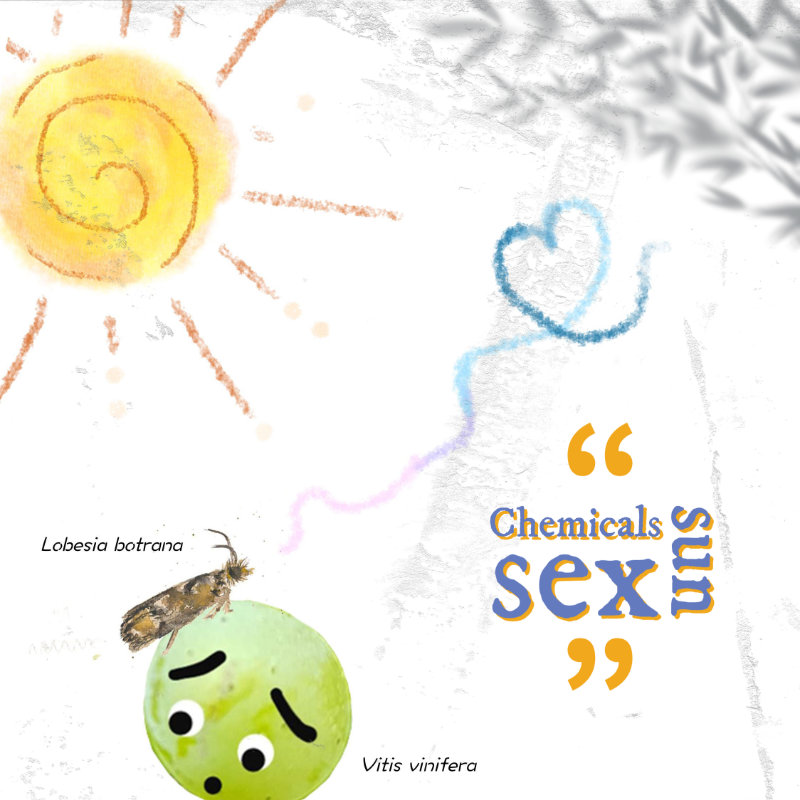 Between chemical and climatic pressures: developmental, reproductive, and physiological responses of the European grapevine moth to Bordeaux mixture exposure under climate warming in Burgundy
Funding: Bourgogne-Franche-Comté region
Started in october 2022
Supervisor: Jérôme Moreau
Defended the 12 december 2025
Abstract
Within agroecosystems, insects are exposed to multiple pressures, both chemical and climatic. Although pesticides are designed to target specific organisms, many of these substances are non-selective and cause collateral damage to a wide range of species. Copper-based fungicides, widely used in viticulture to control fungal diseases, can also affect non-target fauna including the European grapevine moth Lobesia botrana. In the context of climate warming, this southern pest is expected to expand its distribution toward higher latitudes. Rising temperatures could alter the effects of Bordeaux mixture on L. botrana, either by increasing its tolerance to the fungicide or by exacerbating its toxic effects. This thesis therefore aimed to assess the effects of Bordeaux mixture on L. botrana under simulated current (2002 – 2021) and future (2081 – 2100) climate conditions in Burgundy. The results showed that the fungicide negatively affected the pest’s development and reproduction. The future climate scenario mitigated the fungicide’s impact on larval development but enhanced its effects on adult reproduction. Physiological mechanisms underlying these responses were also identified, highlighting an energetic trade-off between defense mechanisms and growth or reproductive processes throughout the pest’s life cycle. This work highlights the importance of considering the interactions between chemical and climatic stressors when assessing pest-related risks. It provides key insights for anticipating the future of viticulture facing rapid environmental change and the multiple threats arising from it.
Keywords
copper-based fungicide; global warming; insect pest; european grapevine moth; development; reproduction; physiology
Thesis advisory panel
Joffrey Moiroux, Avignon University
Marlène Goubault, Tours University
jury
Patricia Gibert, université Claude Bernard Lyon 1 – reviewer
Cécile Le Lann, université de Rennes – reviewer
Joffrey Moiroux, université d’Avignon – examiner
David Siaussat, Sorbonne Université – examiner
Thierry Rigaud, Université Bourgogne Europe – examinateur
Jérôme Moreau, La Rochelle Université – directeur de thèse
- extrait:
- lien_externe:
- titre:
- « Chemicals, sex and sun » : le changement climatique modifie-t-il la réponse des insectes ravageurs aux pesticides ?
- date_de_debut_these:
- octobre 2022
- nom:
- Garinie
- date_de_debut_these_numerique:
- 202210
- kc_data:
- a:8:{i:0;s:0:"";s:4:"mode";s:0:"";s:3:"css";s:0:"";s:9:"max_width";s:0:"";s:7:"classes";s:0:"";s:9:"thumbnail";s:0:"";s:9:"collapsed";s:0:"";s:9:"optimized";s:0:"";}
- kc_raw_content:
- Between chemical and climatic pressures: developmental, reproductive, and physiological responses of the European grapevine moth to Bordeaux mixture exposure under climate warming in Burgundy
Funding: Bourgogne-Franche-Comté region
Started in october 2022
Supervisor: Jérôme Moreau
Defended the 12 december 2025
Abstract
Within agroecosystems, insects are exposed to multiple pressures, both chemical and climatic. Although pesticides are designed to target specific organisms, many of these substances are non-selective and cause collateral damage to a wide range of species. Copper-based fungicides, widely used in viticulture to control fungal diseases, can also affect non-target fauna including the European grapevine moth Lobesia botrana. In the context of climate warming, this southern pest is expected to expand its distribution toward higher latitudes. Rising temperatures could alter the effects of Bordeaux mixture on L. botrana, either by increasing its tolerance to the fungicide or by exacerbating its toxic effects. This thesis therefore aimed to assess the effects of Bordeaux mixture on L. botrana under simulated current (2002 – 2021) and future (2081 – 2100) climate conditions in Burgundy. The results showed that the fungicide negatively affected the pest’s development and reproduction. The future climate scenario mitigated the fungicide’s impact on larval development but enhanced its effects on adult reproduction. Physiological mechanisms underlying these responses were also identified, highlighting an energetic trade-off between defense mechanisms and growth or reproductive processes throughout the pest’s life cycle. This work highlights the importance of considering the interactions between chemical and climatic stressors when assessing pest-related risks. It provides key insights for anticipating the future of viticulture facing rapid environmental change and the multiple threats arising from it.
Keywords
copper-based fungicide; global warming; insect pest; european grapevine moth; development; reproduction; physiology
Thesis advisory panel
Joffrey Moiroux, Avignon University
Marlène Goubault, Tours Universityjury
Patricia Gibert, université Claude Bernard Lyon 1 - reviewer
Cécile Le Lann, université de Rennes - reviewer
Joffrey Moiroux, université d’Avignon - examiner
David Siaussat, Sorbonne Université - examiner
Thierry Rigaud, Université Bourgogne Europe - examinateur
Jérôme Moreau, La Rochelle Université - directeur de thèse