


Julien Giraudo PhD thesis
 Multi-scale characterization of carbon and water flows in the wine-growing regions of Burgundy and Champagne in the context of climate change
Started in may 2025
Funding: 50 Comité Bourgogne (BIVB) & 50% Comité Champagne (CIVC)
Supervisors: Olivier Mathieu, Julien Crétat, Mathieu Thevenot
Abstract
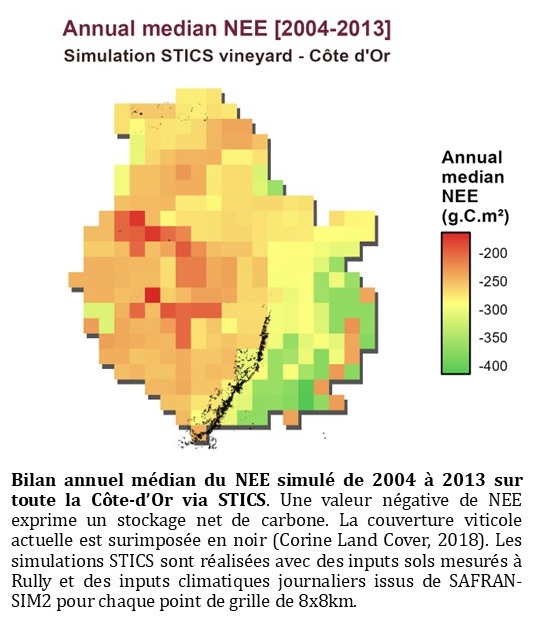
Faced with climate change, winegrowers are confronted with a double challenge: adapting their activity to an increasingly warmer world and contributing to the reduction of greenhouse gas emissions. To help them achieve these objectives, the scientific community must identify the best viticultural practices to implement in order to limit water losses from plots and sequester CO2 sustainably in vine wood and soil. This requires continuous measurement of water and carbon fluxes in vineyards, in the form of evapotranspiration (ET) and net ecosystem exchange (NEE), i.e., the balance between CO2 sequestered by photosynthesis and CO2 released by the respiration of living organisms. These measurements are generally carried out using a flux tower, according to the eddy-covariance method. One of the first flux towers in French vineyards was installed in July 2024 in Rully (Saône-et-Loire), and a three-year project (VITIFLUX, 2025-2028) was co-financed by the Burgundy and Champagne wine industry associations (BIVB & CIVC) in order to meet the sector’s demands. My thesis fits into this context, with the following three objectives: (1) to characterize the annual variability of NEE and ET in the Rully plot, as well as the influence of climate and viticultural practices; (2) calibrate the STICS (INRAe) soil-plant model based on measurements taken in Rully in order to improve the simulation of ET and NEE; (3) use STICS to estimate water and carbon fluxes in other soil contexts in Burgundy and Champagne, under current and future climate conditions (SSP1, SSP2, SSP5). The aim of the project is to offer winegrowers in the region best practices to help them achieve their adaptation and mitigation goals.
Keywords
viticulture ; Eddy-covariance ; carbon ; evapotranspiration
Thesis advisory panel
Katja Klumpp, Loïc Strullu, Benjamin Bois, Thierry Castel
- extrait:
- lien_externe:
- titre:
- Caractérisation multi-échelle des flux de carbone et d’eau au sein des régions viticoles de Bourgogne et de Champagne dans un contexte de changement climatique
- date_de_debut_these:
- mai 2025
- nom:
- Giraudo
- date_de_debut_these_numerique:
- 202505
- kc_data:
- a:8:{i:0;s:0:"";s:4:"mode";s:0:"";s:3:"css";s:0:"";s:9:"max_width";s:0:"";s:7:"classes";s:0:"";s:9:"thumbnail";s:0:"";s:9:"collapsed";s:0:"";s:9:"optimized";s:0:"";}
- kc_raw_content:
- Multi-scale characterization of carbon and water flows in the wine-growing regions of Burgundy and Champagne in the context of climate change
Started in may 2025
Funding: 50 Comité Bourgogne (BIVB) & 50% Comité Champagne (CIVC)
Supervisors: Olivier Mathieu, Julien Crétat, Mathieu Thevenot
Abstract
Faced with climate change, winegrowers are confronted with a double challenge: adapting their activity to an increasingly warmer world and contributing to the reduction of greenhouse gas emissions. To help them achieve these objectives, the scientific community must identify the best viticultural practices to implement in order to limit water losses from plots and sequester CO2 sustainably in vine wood and soil. This requires continuous measurement of water and carbon fluxes in vineyards, in the form of evapotranspiration (ET) and net ecosystem exchange (NEE), i.e., the balance between CO2 sequestered by photosynthesis and CO2 released by the respiration of living organisms. These measurements are generally carried out using a flux tower, according to the eddy-covariance method. One of the first flux towers in French vineyards was installed in July 2024 in Rully (Saône-et-Loire), and a three-year project (VITIFLUX, 2025-2028) was co-financed by the Burgundy and Champagne wine industry associations (BIVB & CIVC) in order to meet the sector's demands. My thesis fits into this context, with the following three objectives: (1) to characterize the annual variability of NEE and ET in the Rully plot, as well as the influence of climate and viticultural practices; (2) calibrate the STICS (INRAe) soil-plant model based on measurements taken in Rully in order to improve the simulation of ET and NEE; (3) use STICS to estimate water and carbon fluxes in other soil contexts in Burgundy and Champagne, under current and future climate conditions (SSP1, SSP2, SSP5). The aim of the project is to offer winegrowers in the region best practices to help them achieve their adaptation and mitigation goals.
Keywords
viticulture ; Eddy-covariance ; carbon ; evapotranspiration
Thesis advisory panel
Katja Klumpp, Loïc Strullu, Benjamin Bois, Thierry Castel