


Victor Hugonnot PhD thesis
 Filling gaps in the story of early microbial life evolution and its consequence on Earth’s oxygenation
Started in october 2025
Funding: ½ HARMI and ½ GS Transbio
Supervisors: Christophe Thomazo & Emmanuelle Vennin
Abstract
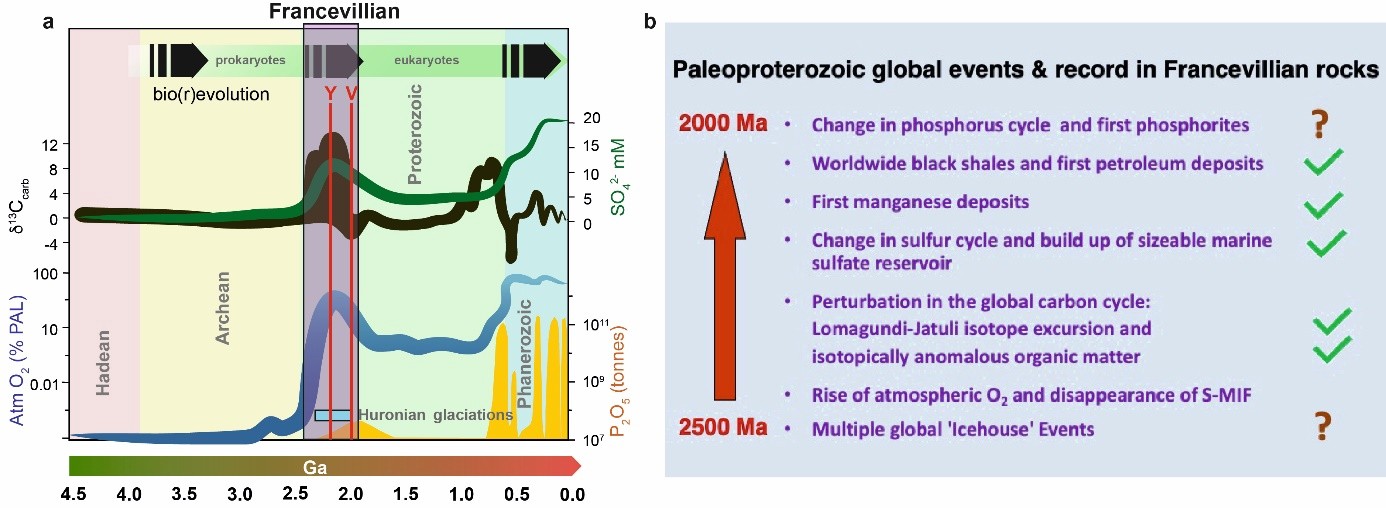
The Paleoproterozoic Era (2500–2000 Ma) witnessed the Great Oxidation Event (GOE), a profound transformation of Earth’s surface environments marked by global glaciations, the massive Lomagundi-Jatuli carbon isotope excursion (LJE), and a reorganization of the sulfur cycle. Despite these upheavals, the response of biogeochemical cycles and sedimentation and the precise sequence of cause-and-effect relationships remain enigmatic. Resolving these questions is hampered by the poor preservation of most sedimentary successions and conflicting interpretations of geochemical proxies, casting doubt on our ability to distinguish global signals from local overprints.
This PhD project leverages the unprecedented opportunity presented by the recently funded GOE-DEEP drilling project in the exceptionally well-preserved Francevillian Basin of Gabon. I will generate a high-resolution sedimentological and multi-proxy geochemical analyses from these new cores to reconstruct the interdependency of carbon, sulfur, and nutrient cycles during this critical period. Specifically, the project will test competing hypotheses for the genesis of the LJE, the drivers of isotopic excursions, and the nature of the post-LJE environmental transition.
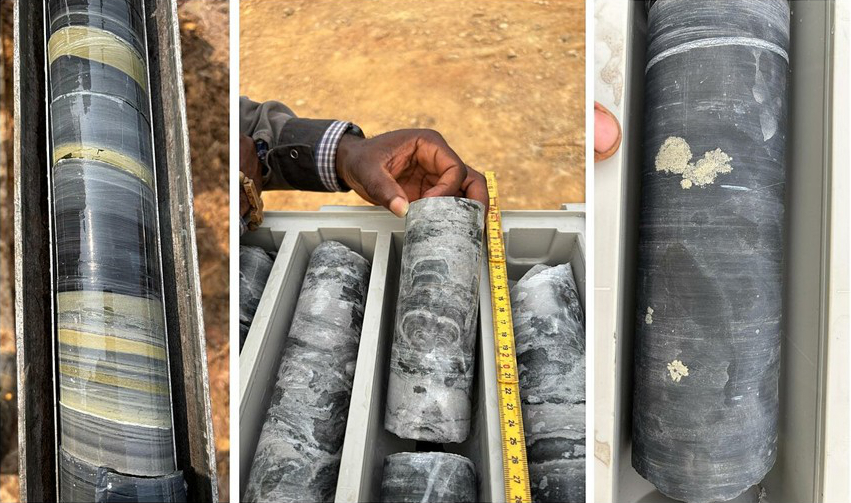 Methodologically, I will use state of the art sedimentological analyses tool together with a suite of well-established isotopic systems (e.g. δ¹³Ccarb, δ¹³Corg, δ³⁴Spyr, δ¹⁵N) integrated with redox-sensitive trace element proxies (U, Mo, V, Cr, REE). This approach will differentiate between primary microbial processes, early diagenetic effects, and later overprints. The goal is to produce a self-consistent model for the timing and tempo of the GOE and its associated biogeochemical cycles, constraining the conditions that facilitated the transition to an aerobic biosphere and the potential early evolution of eukaryotic life.
- extrait:
- lien_externe:
- titre:
- date_de_debut_these:
- octobre 2025
- nom:
- Hugonnot
- date_de_debut_these_numerique:
- 20251001
- kc_data:
- a:8:{i:0;s:0:"";s:4:"mode";s:0:"";s:3:"css";s:0:"";s:9:"max_width";s:0:"";s:7:"classes";s:0:"";s:9:"thumbnail";s:0:"";s:9:"collapsed";s:0:"";s:9:"optimized";s:0:"";}
- kc_raw_content:
- Filling gaps in the story of early microbial life evolution and its consequence on Earth’s oxygenation
Started in october 2025
Funding: ½ HARMI and ½ GS Transbio
Supervisors: Christophe Thomazo & Emmanuelle Vennin
Abstract
The Paleoproterozoic Era (2500–2000 Ma) witnessed the Great Oxidation Event (GOE), a profound transformation of Earth’s surface environments marked by global glaciations, the massive Lomagundi-Jatuli carbon isotope excursion (LJE), and a reorganization of the sulfur cycle. Despite these upheavals, the response of biogeochemical cycles and sedimentation and the precise sequence of cause-and-effect relationships remain enigmatic. Resolving these questions is hampered by the poor preservation of most sedimentary successions and conflicting interpretations of geochemical proxies, casting doubt on our ability to distinguish global signals from local overprints.
This PhD project leverages the unprecedented opportunity presented by the recently funded GOE-DEEP drilling project in the exceptionally well-preserved Francevillian Basin of Gabon. I will generate a high-resolution sedimentological and multi-proxy geochemical analyses from these new cores to reconstruct the interdependency of carbon, sulfur, and nutrient cycles during this critical period. Specifically, the project will test competing hypotheses for the genesis of the LJE, the drivers of isotopic excursions, and the nature of the post-LJE environmental transition.
Methodologically, I will use state of the art sedimentological analyses tool together with a suite of well-established isotopic systems (e.g. δ¹³Ccarb, δ¹³Corg, δ³⁴Spyr, δ¹⁵N) integrated with redox-sensitive trace element proxies (U, Mo, V, Cr, REE). This approach will differentiate between primary microbial processes, early diagenetic effects, and later overprints. The goal is to produce a self-consistent model for the timing and tempo of the GOE and its associated biogeochemical cycles, constraining the conditions that facilitated the transition to an aerobic biosphere and the potential early evolution of eukaryotic life.